Market intelligence

Know what’s changing in your market. Act in a few clicks.

Sigblaze tracks your market, competitors, and customers to uncover what matters. Get evidence-backed insights and clear recommendations, so you know what changed and what to do next.

Private alpha. Pricing is not set.

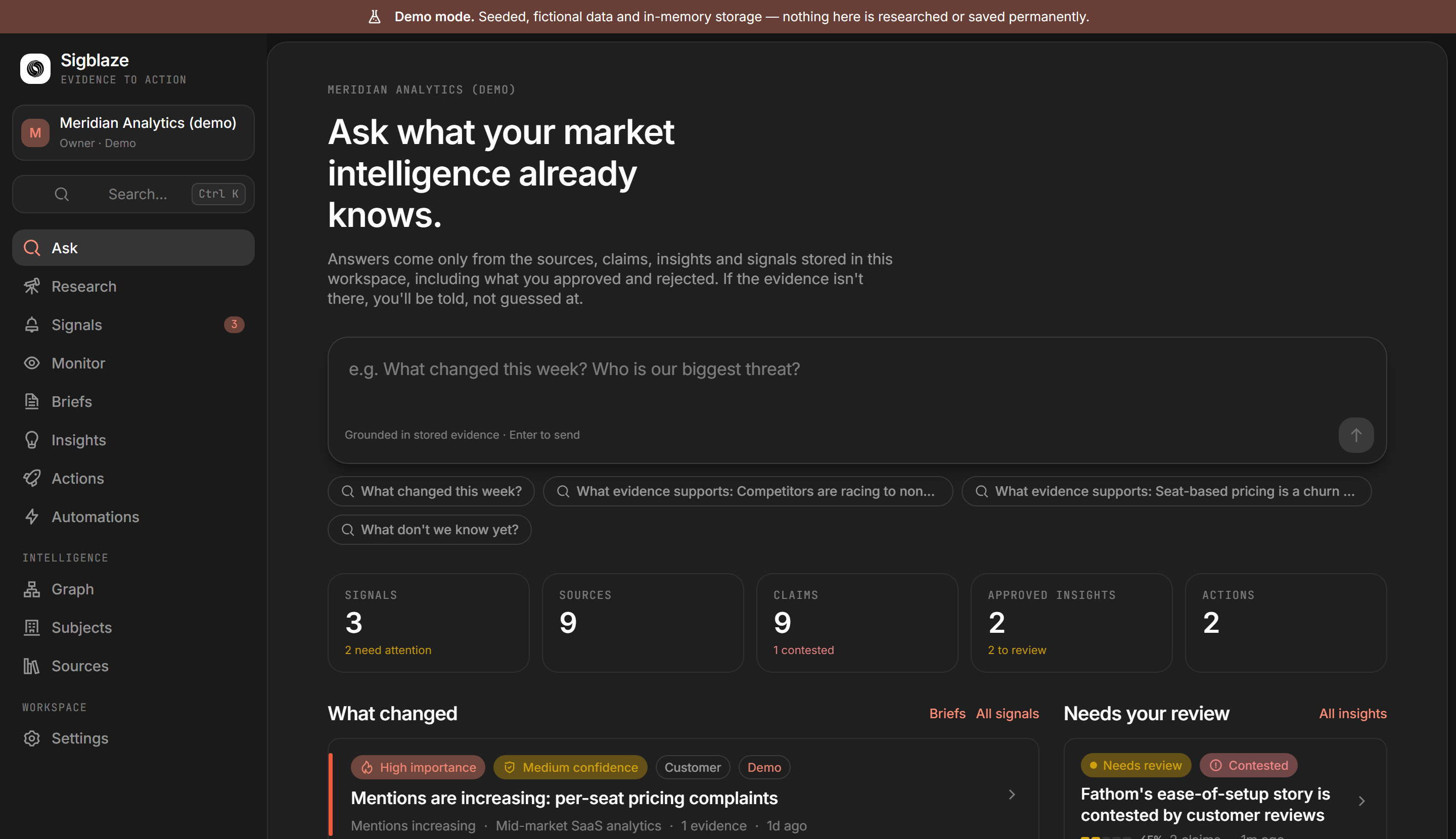
Sigblaze home screen with an Ask box grounded in stored evidence, workspace counts and a feed of what changed.

The Sigblaze home screen. Synthetic demo data with fictional companies and sources.

What changed, what to do next

A detected change arrives with its evidence and next steps

When a watchlist check finds a difference, Sigblaze raises a signal with the before and after, an importance rating, a confidence label and the snapshots behind it.

  • Promote the signal to an insight, update a battlecard or add it to a brief
  • Each step creates a draft you review before anything is reused

How signals work

Illustrative exampleCompetitorPricing changedSG-002

Meridian Pro moved from $49 to $59 per seat

Before · 26 Aug

$49 per seat per month

Pro plan, meridian.example/pricing

After · 5 Oct

$59 per seat per month +20%

Pro plan, meridian.example/pricing

Importance
High
Confidence
High
Evidence
Two stored snapshots of the same page
Next steps
  • Promote to insight
  • Update battlecard
  • Add to brief

Sigblaze creates drafts for you to review. Nothing is sent or published automatically.

Products

Five products that share one evidence graph

Research, Signals, Monitor, Brief and Ask all read from and write to the same stored sources, claims, insights and signals.

Research

Turn a question into a bounded plan, stored sources, single-statement claims and insights.

Explore Research

Signals

See pricing, product, positioning and customer changes with the evidence, an importance rating and a confidence label.

Explore Signals

Monitor

Watchlists re-check competitor pages and searches on a schedule and keep every snapshot.

Explore Monitor

Brief

A daily, weekly or monthly digest of what changed, why it matters and what to do.

Explore Brief

Ask

Answers come from stored evidence, with citations. When there is none, Ask says so.

Explore Ask
Shared layer

Intelligence graph

Every product writes to and reads from one graph, so any signal, insight or action can be traced back to its sources.

  1. Source
  2. Claim
  3. Insight
  4. Signal
  5. Action
  6. Outcome
Explore the graph

From change to action

How a change becomes an action you can trace

One synthetic example, followed through four steps. Each step is stored and links back to the one before it.

01 · Monitor to signal

Each check is compared with the last snapshot

Add pages and searches to a watchlist. The first check is a baseline. Every later check is compared with the last stored snapshot, and a real difference becomes a signal with the before and after.

  • Daily, weekly or on demand
  • Failed checks are shown in the history

Monitor

02 · Evidence and contradictions

Claims keep their sources and disagreement stays visible

Retrieved pages are stored with their type and retrieval date, then split into single-statement claims. Evidence can support, contradict or contextualise a claim. When sources disagree, the claim stays contested until a reviewer decides.

  • The source wording sits beside each claim
  • Each relationship has a text label and an icon

Evidence and claims

sources → claimsSynthetic data
Stored source
S1Vendor pageretrieved 2026-08-26

Meridian pricing and plans

meridian.example/pricing

“Get your whole team live in a day. Per-seat pricing, 10-seat minimum.”

Extracted claims
C-014from S1

Meridian advertises team onboarding “in a day”.

C-021from S1

Meridian prices per seat with a 10-seat minimum.

Each claim keeps its source, so you can open the original wording.
claim / C-014Synthetic data
C-014 Contested

Meridian advertises team onboarding “in a day”.

  • S1SupportsStates it on the pricing page.
  • S2ContradictsReviewer reports ~5 weeks for 14 projects.
  • S3ContradictsClient portals migrate manually.
  • S4ContextualisesA CSV import shipped in July; may predate some reviews.
The claim stays contested. Nothing here picks a winner.
03 · Insight to action

Approved insights become draft actions

An insight links to the claims behind it and carries a confidence label and its freshness. Once a person approves it, it can become a battlecard, a positioning draft, a campaign direction or a report. Each action keeps a trace back to its insight.

  • Contested claims are not worded as facts
  • Export as Markdown or JSON

Actions

04 · Ask

Ask answers from what the workspace has stored

Questions such as “What changed this week?” are answered from stored claims, insights and signals, with citations. When the evidence is missing, Ask says so and offers to start a research run.

  • Answers cite claim and signal IDs
  • A follow-up can become an action draft

Ask

ask / fieldnote workspaceSynthetic data

What changed this week?

Three things were detected. The one that matters most: Meridian raised its Pro price from $49 to $59 per seat [SG-002, C-030]. Complaints about manual portal migration also increased [SG-004]. Tallyhouse added a Slack integration [SG-005].

SG-002C-030SG-004SG-005searched: last 7 days

Turn that into a battlecard against Meridian.

Battlecard drafted from approved insight I-007, with the price change cited. It stays a draft until you review it.

Battlecard · drafttrace → I-007

What do we know about Meridian onboarding?

Meridian advertises onboarding in a day [C-014, S1]. Two agency-side sources report multi-week migrations [C-015, S2, S3], and a July changelog entry notes a new CSV import that may have shortened this since [S4]. The evidence is contested.

C-014C-015S1S2S3S4

What is Meridian's customer churn rate?

The stored evidence does not cover this. No claim in the workspace addresses churn.

Start a research run
Ask answers from stored evidence. When there is none, it says so. A follow-up can become an action.

Comparison

How Sigblaze differs from a one-off AI chat

Chat tools suit one-off questions. Recurring research needs saved context, stored sources and something that keeps watching.

One-off AI chat compared with a Sigblaze workspace
TopicOne-off AI chatSigblaze workspace
ContextRe-explained in every chatSaved workspace context, reused by each run
SourcesLinks in a transcript, if anyStored with type and retrieval date
ClaimsA prose summarySingle statements linked to their evidence
When sources disagreeOften blended into one answerKept visible, and the claim stays contested
Noticing a changeOnly when you ask againWatchlists compare snapshots and raise signals
Weekly digestYou write itA brief built from stored signals
ReviewNoneA person approves or rejects before reuse
Tracing an actionNot keptAction to insight to claims, signals and sources

Method

How a recommendation is traced back

A reviewer can inspect the chain behind any conclusion in Sigblaze, including the changes it detected.

  1. 01

    Sources are stored

    Each source is saved with its type, origin and retrieval date.

  2. 02

    Claims link to evidence

    Evidence is labelled as supporting, contradicting or contextual.

  3. 03

    Disagreement stays visible

    A contested claim is not averaged into one confident answer.

  4. 04

    Changes are compared

    A signal comes from two stored snapshots. A model can help word it but does not decide that something changed.

  5. 05

    People approve

    A model proposes. A person approves or rejects insights and actions before they are reused.

  6. 06

    Runs record their inputs

    Each run and check records the context version and the sources it used.

Read the methodology

Current status

What exists in the private alpha, and what does not yet

Both lists come from one capability registry, so this page cannot promise more than the product does.

In the private alpha

  • Workspace contextCompany, product, ICP, market and competitor context that every research run inherits.
    Private alpha
  • Research goals and plansA goal becomes a bounded set of tasks and queries instead of one giant prompt.
    Private alpha
  • Live retrieval and sourcesRetrieved pages are normalised and de-duplicated into stored sources with provenance metadata.
    Private alpha
  • Atomic claimsSources become single-proposition claims linked to the evidence behind them.
    Private alpha
  • Contradiction visibilityEvidence can support, contradict or contextualise a claim; disagreement is preserved.
    Private alpha
  • InsightsInterpretations synthesised from stored claims, with confidence and freshness metadata.
    Private alpha
  • Human reviewApprove or reject insights and actions before they are reused or exported.
    Private alpha
  • WatchlistsCompetitor, customer, market and topic watchlists made of public pages and search queries.
    Private alpha
  • Change detectionEach check is compared with the last stored snapshot; only real differences become candidates.
    Private alpha
  • Scheduled checksDaily or weekly re-checks, plus run-now. Scheduling needs a cron trigger on self-managed deployments.
    Private alpha
  • Historical snapshotsObservations are kept, so you can see how a page changed rather than only its latest state.
    Private alpha
  • SignalsDetected pricing, product, positioning, customer and market developments, each with evidence, confidence and importance.
    Private alpha
  • Signal triage and promotionAcknowledge or dismiss a signal, or promote it to a draft insight for review.
    Private alpha
  • Mention-volume trendsA jump in new sources matching a watchlist is raised as a trend signal.
    Private alpha
  • BriefsDaily, weekly, monthly or on-demand digests: what happened, why it matters, what to do.
    Private alpha
  • Ask from stored evidenceQuestions answered from the workspace's own claims, insights, signals and sources, with citations.
    Private alpha
  • Time-aware and gap questions“What changed this week?” and “What don't we know yet?” answered from stored state.
    Private alpha
  • Ask to actionTurn an answer that rests on approved insights into a positioning, campaign or battlecard draft.
    Private alpha
  • Evidence-linked actionsPositioning, campaigns, content, battlecards, outreach, product opportunities and reports.
    Private alpha
  • Intelligence graphOne shared lineage from sources to outcomes; trace any signal, insight or action both ways.
    Private alpha
  • Outcome trackingRecord what happened after an approved action; counts by action type show what has worked.
    Private alpha
  • Markdown and JSON exportTake approved intelligence out of the workspace.
    Private alpha

Later, not available today

  • Email and chat alertsPush notifications when a high-importance signal is raised. Signals are in-app today.
    Later
  • Social, app-store and video monitoringReddit, social, app stores, YouTube and review-site feeds as dedicated sources.
    Later
  • Automated learning from outcomesUsing recorded outcomes to rank which intelligence is most likely to lead somewhere.
    Later
  • Saved research templatesReusable research setups.
    Later
  • Uploaded-document retrievalResearch over your own documents.
    Later
  • CSV and PDF exportRicher export formats.
    Later
  • White-labelled agency reportsClient-ready branded deliverables.
    Later
  • First-party integrationsConnections to CRM, analytics and other internal systems.
    Later
  • Billing and usage meteringSelf-serve plans and usage.
    Later
  • Enterprise governanceAdvanced admin and compliance controls.
    Later

FAQ

Common questions

What is Sigblaze?

Sigblaze is a market intelligence product. It researches your market, competitors and customers, checks them again on a schedule, raises a signal when something meaningful changes, and turns reviewed evidence into actions for marketing, sales, product and strategy. Sources, claims, contradictions, insights and signals are stored in the workspace, so the next question starts from what is already known.

Who is it for?

Boutique B2B agencies running research for several clients, fractional CMOs and GTM consultants, B2B SaaS teams, and founders or product marketers who research competitors and markets on a recurring basis.

How is it different from ChatGPT or Perplexity?

General AI tools are good for one-off questions and exploration. Sigblaze is built for recurring team research: it stores workspace context, keeps sources and claims, shows contradictions, preserves lineage and lets a team reuse approved intelligence in later research and actions.

How does research planning work?

You state a research goal, and the product turns it into a bounded plan of tasks and queries. Each task inherits the workspace's company, product, ICP, market and competitor context, so one vague prompt does not have to carry everything.

What is a claim?

A claim is one factual statement extracted from a source. It stays linked to the evidence that supports, contradicts or adds context to it.

What happens when sources disagree?

The disagreement is kept. A claim with contradicting evidence is shown as contested, and the system does not silently pick a preferred fact.

How are insights generated?

An insight is an interpretation written from stored claims and evidence. It keeps the claim relationships, confidence and freshness that produced it, and a person reviews it before it is reused.

Can I ask follow-up questions?

Yes. Ask answers from the workspace's stored context, claims, insights, signals and sources, including what you approved or rejected, and it can answer questions such as “what changed this week?”. When the stored evidence is not enough, it says so instead of presenting general model knowledge as workspace evidence.

All questions

Join the waitlist for the private alpha

Sigblaze is built for agencies, fractional GTM teams and B2B SaaS teams that research the same markets on a schedule. Pricing is not set.